
What Is a Church Technology Stack?
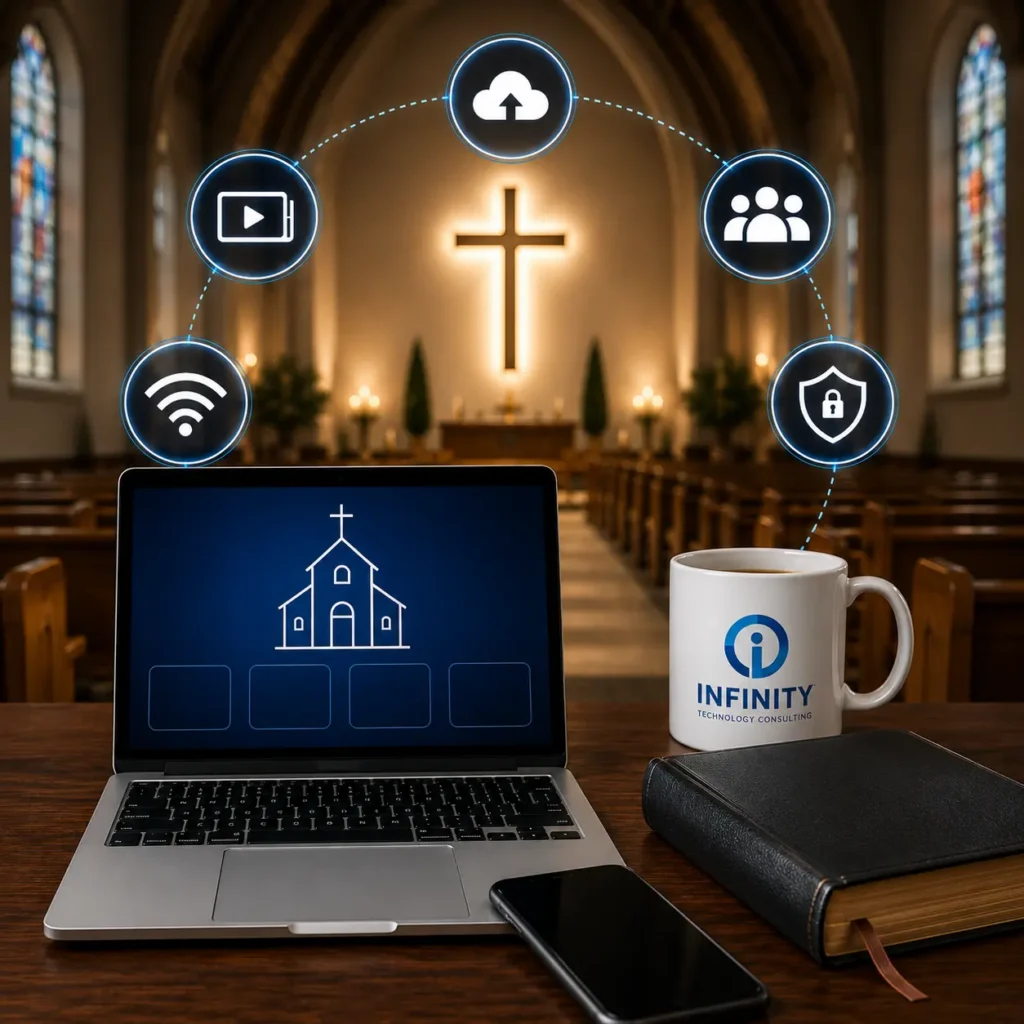
A church technology stack is the integrated set of hardware, software, cloud services, security systems, and operational tools used to manage church IT operations efficiently and securely.
It typically includes network infrastructure, Church Management Software (ChMS), accounting platforms, communication tools, cybersecurity solutions, and audio-visual systems. These components work together as a unified ecosystem rather than isolated tools.
If you think of church operations like a living organism, the tech stack is the nervous system. It connects departments, processes information, protects sensitive data, and ensures smooth day-to-day functionality. Without structure, operations become fragmented.
Why Modern Churches Require Structured IT Infrastructure
Churches today operate more like midsize nonprofit organizations than small community groups. They manage donor databases, recurring digital transactions, volunteer coordination, multi-campus broadcasting, and confidential member records.
Recent industry reports indicate that nonprofit organizations, including religious institutions, have experienced a measurable rise in cybersecurity incidents over the past five years. Many breaches occur due to weak password policies, outdated firewalls, or lack of staff training.
Infinity Technology Consulting approaches church infrastructure from a risk-based and growth-oriented perspective. The goal is not complexity. It is operational clarity, compliance alignment, and long-term scalability.
Core Infrastructure: Network Architecture and Cloud Foundations
Every reliable church tech stack begins with stable infrastructure. This includes enterprise-grade firewalls, managed switches, VLAN segmentation, secure Wi-Fi networks, endpoint devices, and structured cabling systems.
Cloud computing plays a central role. SaaS (Software as a Service) platforms reduce on-site server maintenance and improve accessibility. Hybrid cloud architecture allows churches to maintain on-premise AV systems while leveraging cloud-based productivity tools.
Downtime during worship services or live streams often traces back to weak infrastructure design. Proper bandwidth allocation, Quality of Service (QoS) configuration, and network redundancy prevent interruptions and protect operational continuity.
Contact Your Best Consultants
Church Management Software (CHMS) as the Operational Database
Church Management Software (ChMS) serves as the centralized data repository for member records, attendance tracking, volunteer scheduling, small group management, and communication logs.
Instead of spreadsheets scattered across departments, ChMS consolidates engagement data into structured dashboards. This improves reporting accuracy and eliminates duplication. When integrated with online giving and communication systems, it creates a unified data ecosystem.
Structured data visibility supports informed leadership decisions. Attendance trends, volunteer retention rates, and engagement metrics become measurable rather than anecdotal.
Financial Systems, Fund Accounting, and Compliance Standards
Financial transparency is fundamental in church operations. Unlike for-profit businesses, churches must adhere to nonprofit accounting principles, including fund accounting and restricted donation tracking.
Standards such as GAAP (Generally Accepted Accounting Principles) and Financial Accounting Standards Board (FASB) guidelines apply to nonprofit entities. Proper accounting software must support donor restrictions, grant allocations, audit trails, and financial reporting integrity.
Online giving platforms require PCI-DSS (Payment Card Industry Data Security Standard) compliance. Encryption, tokenization, and multi-factor authentication reduce the risk of financial fraud. Integration between ChMS and accounting systems prevents data inconsistencies and strengthens stewardship reporting.
Cybersecurity Framework for Churches
A church cybersecurity framework is a layered security model designed to protect sensitive data, financial systems, and digital infrastructure from unauthorized access, breaches, or ransomware attacks.
This includes firewall protection, endpoint detection and response (EDR), email filtering, encrypted backups, multi-factor authentication (MFA), and staff cybersecurity awareness training.
According to nonprofit cybersecurity assessments, human error remains one of the leading causes of data breaches. That means technical controls alone are not enough. Policies, password management standards, and incident response planning are equally critical.
Infinity Technology Consulting emphasizes defense-in-depth strategy, ensuring that if one layer fails, additional safeguards remain active.
Contact Your Best Consultants
Communication, Collaboration, and Productivity Platforms
Church staff and volunteer teams require structured collaboration tools. Platforms such as Microsoft 365 or Google Workspace centralize document storage, email communication, shared calendars, and secure file access.
Role-based access control ensures that sensitive data remains restricted to authorized personnel. Cloud-based collaboration reduces reliance on personal devices and informal messaging systems.
Externally, communication tools integrate email marketing, SMS messaging, and mobile engagement platforms. Structured communication systems support member engagement while maintaining compliance with privacy regulations.
Audio, Video, and Live Streaming Systems
Modern worship services rely heavily on audio-visual infrastructure. Digital mixing consoles, projection systems, LED displays, PTZ cameras, and streaming encoders form the technical backbone of in-person and online services.
Live streaming has become a standard component of ministry outreach. Proper bandwidth provisioning, redundant internet connections, and dedicated streaming VLANs prevent disruptions.
Volunteer training is equally important. Standardized AV workflows, documented signal routing diagrams, and scheduled maintenance ensure consistent service quality.
Data Analytics, KPIs, and Ministry Intelligence
Data analytics transforms raw information into actionable insight. Churches can track Key Performance Indicators (KPIs) such as attendance growth, volunteer retention, giving frequency, and engagement participation.
Business intelligence dashboards aggregate data from ChMS, accounting software, and communication platforms. This enables predictive planning rather than reactive adjustments.
Analytics does not replace pastoral care. It enhances it. If engagement declines in a specific ministry area, leaders can respond intentionally rather than relying on guesswork.
Contact Your Best Consultants
Automation, API Integrations, and Workflow Optimization
Disconnected systems create administrative burden. API (Application Programming Interface) integrations allow platforms to share data automatically.
For example, a new visitor registration can trigger automated follow-up emails, volunteer task assignments, and database updates. This reduces manual data entry and human error.
Workflow automation strengthens operational efficiency. When repetitive processes are streamlined, staff and volunteers can focus on mission-driven responsibilities rather than technical maintenance.
IT Governance, Policy Documentation, and Risk Management
Technology without governance increases risk exposure. Churches require documented policies covering acceptable use, password standards, data retention, vendor evaluation, and device management.
Risk management includes regular system audits, backup verification testing, and cybersecurity assessments. Documentation ensures continuity during leadership transitions. Formal governance transforms technology from reactive troubleshooting into strategic asset management.
Scalability, Digital Transformation, and Future-Ready Planning
Growth introduces complexity. Multi-campus expansion, increased streaming demand, and rising digital engagement require scalable infrastructure.
Cloud-first strategies, modular AV systems, and subscription-based SaaS platforms allow predictable expansion. Hardware lifecycle planning prevents emergency capital expenditures.
Emerging technologies such as AI-driven analytics, automated transcription, and enhanced cybersecurity monitoring are reshaping church digital transformation strategies. Structured planning ensures adaptation without disruption.
Building a Sustainable, Secure Church Technology Ecosystem
A church tech stack is not about adding tools. It is about building an interconnected ecosystem that supports ministry operations, protects sensitive data, and ensures financial transparency.
Infrastructure, ChMS, accounting platforms, cybersecurity systems, collaboration tools, AV infrastructure, analytics, and automation must function as a cohesive architecture.
Infinity Technology Consulting advocates structured implementation, compliance alignment, and long-term scalability planning. When technology is stable and secure, ministry operates with clarity and confidence.
Technology should quietly empower mission—not distract from it.
Contact Your Best Consultants
frequently asked questions
What are the core components of a church technology stack?
Core components include network infrastructure, Church Management Software (ChMS), accounting systems, cybersecurity tools, communication platforms, and AV systems.
Why is fund accounting important for churches?
Fund accounting ensures restricted donations are tracked properly and used according to donor intent, aligning with nonprofit compliance standards.
How often should churches conduct cybersecurity assessments?
At minimum, annual assessments are recommended, with quarterly vulnerability reviews and continuous monitoring for emerging threats.
Can small churches benefit from automation and integrations?
Yes. Even smaller congregations reduce administrative workload and improve accuracy through basic API integrations and workflow automation.
What makes a church tech stack scalable?
Cloud-based platforms, modular hardware systems, structured governance, and lifecycle planning enable predictable growth without operational disruption.