
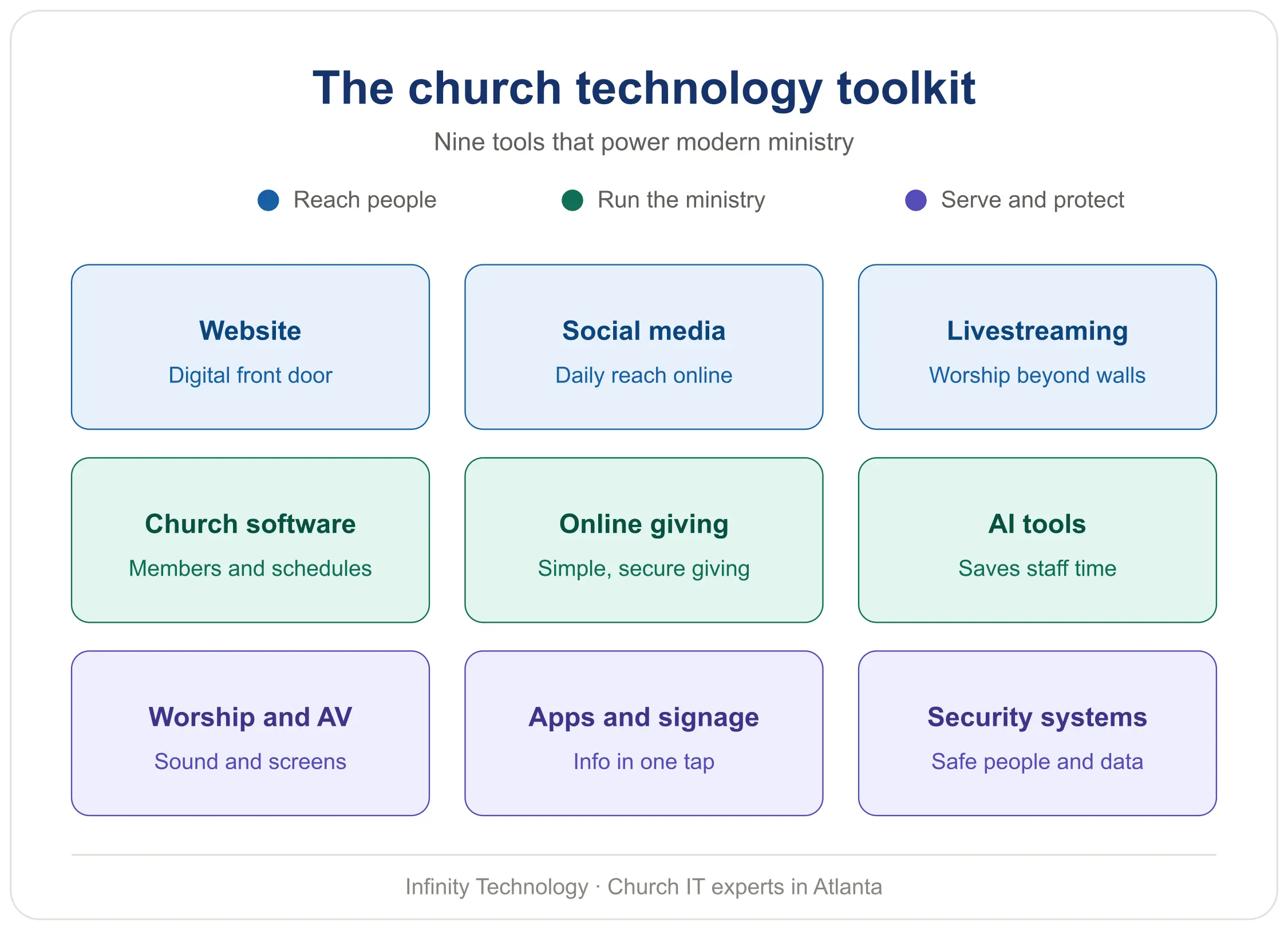
Technology in the church means the digital tools a church uses to reach people and run its ministry. These tools include websites, social media, livestreaming, church management software, online giving, mobile apps, audio and video gear, and security systems. When a church uses them wisely, technology strengthens ministry. It helps the church communicate clearly, reach more people, and serve its community better.
Technology has changed almost everything about daily life. We talk, learn, shop, work, and stay close to the people we love through our screens. So it makes sense that technology now shapes how churches serve their communities too.
Not long ago, a church ran on printed bulletins, phone calls, and face to face meetings. Today, a church can reach someone across the world in a few taps. That shift happened fast, and it keeps moving.
Some people worry that all this tech might push out the personal, human side of church. That worry is fair. But here is the truth. When you use it the right way, technology never replaces ministry. It strengthens it. Picture tech as a bridge. It connects your church to more people, carries your message farther, and helps you serve in ways nobody imagined a generation ago.
What Does Technology in the Church Mean?
Technology in the church means all the digital tools, software, and equipment a church uses to support its ministry. That covers a lot of ground, so let’s make it simple.
Common examples include:
- Church websites
- Livestreaming platforms
- Social media accounts
- Church management software
- Online and mobile giving tools
- Audio and video equipment
- Digital signage and screens
- Mobile church apps
- Email and text messaging tools
- Security cameras and check in systems
At its heart, technology is just a tool. A microphone amplifies the pastor’s voice so the back row hears clearly. In the same way, digital tools amplify the church’s message so it travels far beyond the building. The tool never becomes the point. The message stays the point. Tech simply helps it reach more ears and hearts.
How Has Technology Changed Modern Ministry?
Technology has reshaped ministry in a big way over the past ten years, mostly because people changed. We now expect instant answers, and we expect them on our phones.
When someone wants to check out a church, what do they do first? They search online. They scan the website, glance at the social media pages, look up service times, and watch a sermon clip long before they ever decide to visit.
This means your church no longer serves only the people who walk through the front doors. It also serves a crowd of people who watch, read, and explore online. In a real sense, technology stretches your mission field wider than ever before.
With the right tools, your church reaches people far outside the neighborhood, shares sermons online, organizes volunteers in seconds, accepts gifts digitally, and builds community all week instead of only on Sunday.
What Are the Benefits of Technology in the Church?
So what does a church actually gain from all this? Quite a lot, when the tools fit the mission. Let’s look at the three biggest wins.
Better Communication
Communication trips up almost every church. Members need to know about events, service times, volunteer needs, prayer requests, and program changes. Word of mouth rarely covers it all.
Technology solves this fast. Your church sends email newsletters, text alerts, app notifications, and social media posts whenever news breaks, instead of waiting for Sunday. As a result, people stay informed, feel included, and stay connected through the whole week.
Stronger Community Engagement
Church does not stop when the service ends, so your connection should not either. Social media lets your church encourage, teach, and celebrate people every single day. You post sermon clips, share testimonies, promote events, and answer questions from curious visitors.
Remember this. Your online presence often gives someone their very first impression of your church. Before a person shakes a hand or sings a song, they already met your church on a screen. A warm, active online presence makes that first meeting count.
Smoother Church Administration
Running a church takes a mountain of behind the scenes work. Your team juggles membership records, volunteer schedules, event planning, finances, and attendance. Doing all of that by hand eats up hours and invites mistakes.
Church management software handles the heavy lifting. It automates the boring, repetitive tasks so your team spends less time wrestling spreadsheets and more time with people. That frees leaders to actually lead, which is the whole point.
Why Does Every Church Need a Website?
If your church owns only one piece of technology, make it a good website. Think of it as your digital front door. Most people knock there before they ever step inside the building.
Picture a young family new to town. They want quick answers. What time are services? Where is the church? What do you offer for our kids? What does this church believe? A clear, friendly website answers all of that in under a minute.
A strong church website includes service times, location and directions, a sermon library, an event calendar, a simple contact form, and an easy way to give. When your website does its job, a visitor feels welcome before they even park the car. When it sits empty or messy, you quietly lose people you never knew were looking.
How Can Churches Use Social Media for Outreach?
Where do people spend hours every day? On their phones, scrolling Facebook, Instagram, YouTube, and TikTok. Social media lets your church show up right where people already gather.
Used well, social media works like leaving the church doors open every day. Your church posts daily encouragement, shares short clips from Sunday’s message, introduces the staff, celebrates baptisms, and invites people to the next event. Each post opens another small door.
Here is the best part. A single sermon clip can reach someone who would never walk into a church on their own. Social media does not replace real community, but it plants seeds and starts conversations that lead people toward it.
What Is Church Management Software?
Church management software, often called a ChMS, acts as the church’s command center. Popular tools include Planning Center, Breeze, and ChurchTrac, and they quietly power a huge amount of ministry.
A good ChMS keeps your member database, attendance records, volunteer schedules, event signups, and giving history all in one tidy place. Instead of digging through paper files and scattered spreadsheets, your team finds everything with a quick search.
Even better, these tools hand you useful insights. You see which ministries grow, who has not attended in a while and might welcome a call, and how giving shifts across the year. That clear picture helps leaders make smarter, more caring decisions.
How Does Technology Improve Worship?
Technology has reshaped the worship experience in a big way. Walk into most churches now and you spot digital sound boards, projectors, bright screens, presentation software, and stage lighting all working together.
These tools serve one simple goal. They help everyone see and hear clearly. Lyrics, Bible verses, and announcements appear plainly on screen. Strong sound systems carry the message to every seat, whether someone sits up front or in the back corner.
The trick is balance. When the tech runs smoothly, it slips into the background and lets worship shine. When it glitches, it grabs everyone’s attention for the wrong reasons. The best church tech is the kind nobody notices, because it simply works.
How Does Online Giving Help Churches?
Be honest. When did you last carry cash to a store? Most people rarely do anymore, and that habit changed how they give. Fewer folks drop bills or checks in a plate, so churches added easier ways to give.
Today many churches offer online giving, mobile giving, giving by text, and recurring donations. These options let people support the church right from their phone, anytime, from anywhere. That convenience makes a real difference.
Digital giving also steadies a church’s finances. Recurring gifts keep arriving even when someone misses a Sunday or travels out of town. Offering several giving options simply meets people where they live and makes generosity easy.
Do Mobile Apps and Digital Signage Matter?
A couple of smaller tools deserve a quick mention. A church mobile app puts everything in one spot on a member’s phone, including sermons, the calendar, giving, prayer requests, and notifications. For active members, the app becomes a daily touchpoint with the church.
Digital signage, those screens in the lobby and hallways, replaces the old printed flyers pinned to a corkboard. The screens look sharp, update in seconds, and point visitors toward the right room or the next big event. Small upgrades like these add a polished, welcoming feel.
How Can Churches Use Artificial Intelligence (AI)?
Artificial intelligence, or AI, has quickly become one of the most talked about tools in ministry, and for good reason. AI helps pastors and ministry leaders handle everyday tasks faster, which frees up valuable staff time for the work only people can do.
Here are a few ways churches already put AI to work:
- Sermon research. Pastors use AI to gather background on a Bible passage, pull related verses, and spark fresh ideas, which speeds up study without replacing prayer or personal reflection.
- Discipleship strategy. Leaders lean on AI to map out study plans, suggest small group topics, and shape clear next steps for new believers.
- Communication materials. Staff use AI to draft newsletters, social media captions, event invites, and announcements in a fraction of the usual time.
The biggest gift AI gives a church is time. When a tool handles the first draft or the busywork, your team reclaims hours for counseling, visiting, and discipling people face to face.
Still, lean on AI with wisdom. Treat it as an assistant, not the author. Always review what it creates, add your own voice and heart, and let prayer and Scripture lead the way. AI sharpens the pencil, but your people still write the story.
How Can Churches Keep Their Data Safe?
Here is a question worth sitting with. Would you leave the offering on a table by an unlocked door overnight? Of course not. So why leave your digital doors wide open? Churches hold sensitive information like member records, giving history, and financial details, and that makes them a target for scammers and hackers.
The good news is that strong security does not require a tech degree. Start with the basics. Build strong, unique passwords. Turn on a second login step, which adds another lock to your accounts. Update your software often, since updates patch security holes. Train your team to spot fake emails that try to trick people into clicking bad links.
Protecting data goes beyond a technical chore. It builds trust. People share their information with your church because they believe you will guard it well. Solid security keeps that trust strong and protects the church’s good name. If you want a deeper plan, our team can walk you through the cybersecurity steps every church should take.
What Are the Biggest Church Technology Challenges?
Technology brings plenty of good, but let’s keep it real. It also brings a few headaches. Knowing them ahead of time helps you handle them with grace.
Tight budgets. Tech costs money, and church budgets stay lean. The fix? Start with your goals, not the gadgets. Buy what serves the mission and skip the shiny extras you do not need yet.
Training needs. New tools only help when people know how to use them. Without training, expensive software gathers dust. Plan simple, ongoing training so your team feels confident instead of confused.
Pushback on change. Some members love the old ways and feel uneasy about new screens and apps. That reaction is natural. Introduce changes slowly, explain the reason behind them, and keep some familiar elements in place so nobody feels left behind.
Technical hiccups. Equipment fails and software acts up at the worst moments. A little planning, like a backup plan and reliable support, keeps a small glitch from turning into a Sunday meltdown.
How Can a Church Use Technology Wisely?
So how do you get this right? You do not need to be a tech genius. You just need a smart, simple approach. Here are the habits that set thriving churches apart.
Let ministry lead. Always start with your goals, then choose tools that serve them. The technology should support the mission, never steer it.
Build on a solid foundation. Your tools sit on top of your network, so a steady connection and a secure setup matter more than most people realize. We dig into that fully in our guide on why reliable internet matters for ministry, so we will keep it short here. Get the foundation right first.
Train your people. Offer steady, friendly support so staff and volunteers feel equipped instead of overwhelmed.
Guard your data. Treat security as a regular habit, not an afterthought.
Review often. Tech changes quickly. Check your tools a couple of times a year to make sure they still fit your church and your budget. For help choosing the right mix, see our breakdown of the essential tech stack for church operations.
Does a Church Need Professional IT Help?
Let’s ask an honest question. Did your pastor attend seminary to fix Wi-Fi and troubleshoot software? Almost certainly not. Most church leaders never signed up to run an IT department, and they should not have to.
A small church might get by with a handy volunteer. But as a church grows, the tech piles up fast. Livestreams, giving systems, security cameras, member data, and maybe several campuses all need care. At some point, handling it on your own stops saving money and starts creating risk.
That is when a professional church IT partner earns its keep. A team that focuses on church technology understands the Sunday rush, the systems that cannot fail, and the data that must stay safe. Infinity Technology specializes in church IT for congregations in Atlanta and beyond. We set up secure, reliable systems and provide managed IT support so your team can stop worrying about tech and get back to people. Ready for technology that simply works? Reach out to Infinity Technology today.
What Is the Future of Technology in the Church?
Where does all this head next? The road ahead looks exciting. Artificial intelligence will keep getting smarter and take on more of the heavy lifting, from deeper research to live translation for people who speak other languages. Expect AI to become a steady helper across more corners of ministry.
Online and hybrid ministry will keep growing too. More churches will treat their online campus as a real community, not just a video feed. Giving will get even simpler, security will get smarter, and cloud tools will let leaders run ministry from anywhere.
But here is the heart of it. None of these tools change the church’s true mission. A hammer never builds the house. The carpenter does. In the same way, technology never does ministry. People do. The wisest churches will grab these powerful new tools to do timeless work, reaching hearts and building real community in fresh ways.
Conclusion
Technology now stands at the center of modern ministry. From websites and livestreaming to social media, online giving, and management software, digital tools help churches reach more people, communicate clearly, and run more smoothly.
When you use it wisely, technology strengthens ministry instead of replacing it. It opens new doors, sparks new conversations, and frees leaders to spend more time with people and less time on paperwork. The key word stays balance. Tech should never crowd out personal relationships or spiritual growth. It should serve them.
The church’s mission has not changed, and it never will. Technology simply gives us fresh ways to carry that timeless message forward. Churches that choose the right tools, build a solid foundation, and use them with purpose will stand ready to serve, grow, and change lives for generations. Start where you are, keep it simple, and let your technology do the quiet work of helping your church shine.
Frequently Asked Questions
1. What is technology in the church?
Technology in the church means all the digital tools a church uses to support ministry, including websites, social media, livestreaming, church management software, online giving, mobile apps, audio and video equipment, and security systems. In short, any tool that helps a church share its message and serve people counts as church technology.
2. Why is technology important in the church?
Technology matters because it helps churches communicate clearly, reach people beyond the local area, run operations smoothly, and engage members all week. It also frees staff and volunteers from busywork so they can focus more on people and ministry.
3. What technology should every church have?
Most churches benefit from a clear website, a steady network, church management software, online giving tools, and quality audio and video equipment. Social media accounts and strong security round out the basics. Start with the tools that match your goals, then grow from there.
4. Does technology replace traditional ministry?
No. Technology supports ministry, but it never replaces it. The right tools help churches serve people better and reach a wider audience, yet they cannot replace personal relationships, spiritual leadership, or real community.
5. How can churches keep their technology and data safe?
Churches protect their tech by building strong passwords, turning on a second login step, updating software often, training staff to spot scams, and securing their networks. Many churches also partner with a professional IT provider to lock everything down the right way.
6. How can churches use AI?
Churches use AI to speed up sermon research, shape discipleship and small group plans, and draft communication materials like newsletters and social media posts. AI saves staff time on routine tasks, but leaders should treat it as an assistant, review its work, and let prayer and Scripture guide the final result.